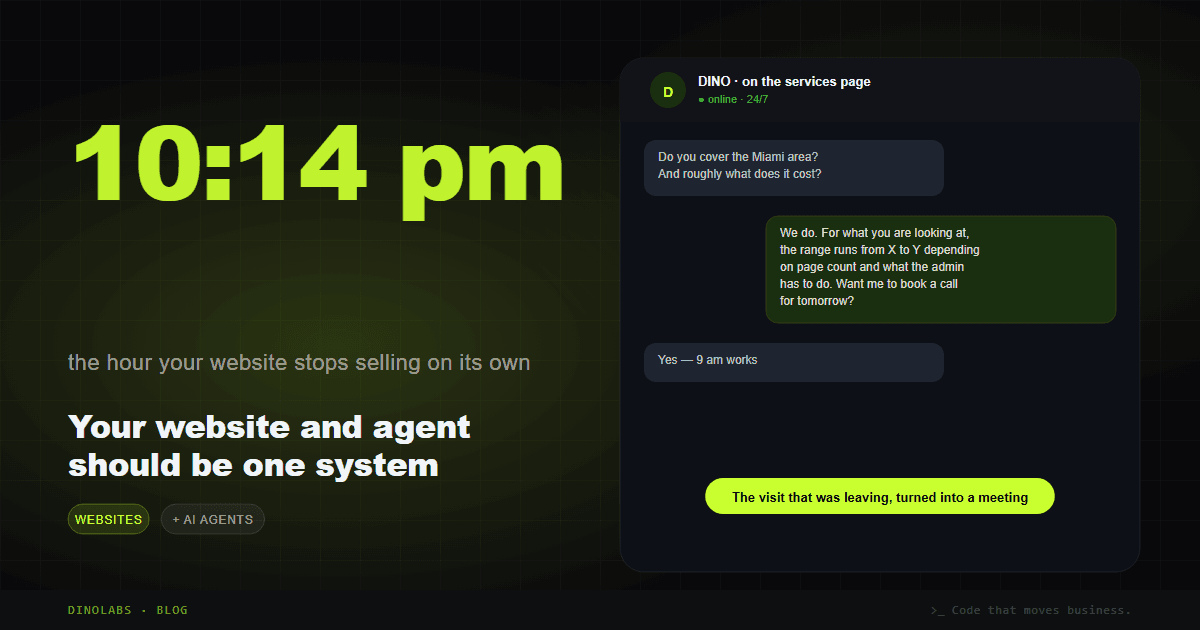
Your website and your AI agent should be one system, not two
Most companies buy the website from one vendor and the agent from another, and end up with two tools that never talk. Connected, they do something neither does alone: turn the visit into a conversation before it leaves.
A website with an AI agent outperforms either piece on its own because it closes the gap between the visit and the contact. The site attracts and explains; the agent answers at the exact moment the question appears, using the real information published on the site, and records the contact. Separately, a visitor who cannot find an answer leaves without a trace. Together, that same visit becomes a conversation with a name, a phone number and context for your sales team.
Published on September 3, 2026
The problem: two systems that never talk
The usual sequence goes like this. A company builds a good-looking website. Months later it adds a chat widget or an agent. And it ends up with two things living in separate worlds: the site does not know the agent exists, and the agent does not know what the site says.
The symptom shows up every day. A visitor reads a service page, has one concrete question — do you cover my area, does this work at my company size, roughly what does it cost — and cannot find the answer. Two options: fill out a form and wait, or leave. Most leave, and that visit produces no name at all.
The data has been consistent for years. The Harvard Business Review analysis of how quickly online leads go cold found that contacting within the first hour changes the odds of qualifying dramatically. A form answered the next morning reaches a prospect who already spoke to three competitors.
A website with an AI agent removes that wait. The question gets answered where it appears, on the page itself, and the conversation is recorded even when the person does not buy today.
What the website gains when the agent lives inside it
The site stops being a brochure and becomes an intake channel that works overnight.
- It recovers the visit that was leaving. People who never fill out forms will happily type a question. Those are different personalities, and today you are only capturing one of them.
- It converts outside business hours. A large share of traffic arrives at night and on weekends. Without an agent, that traffic only browses.
- It qualifies before your team gets involved. The agent asks about location, size, need and rough budget, so your rep receives an organized contact.
- It tells you what the site is missing. The questions that repeat most in chat are exactly the sections your site lacks. That is free content research.
That last point is the most underrated. After a month of the agent running, you have an ordered list of what prospects do not understand about your offer. It feeds the blog, the service pages and even how your team pitches. We go deeper on how that shapes a modern B2B site in building a B2B website for AI search.
What the agent gains when it lives on the site
The reverse direction matters just as much. An agent connected to the site answers better than one fed by hand.
- A single source of truth. If prices and services are published on the site, the agent reads them there. Update the site and the agent is updated, with no second list drifting out of sync.
- Page context. Someone writing from the home page is not the same as someone writing from a specific service page. An agent that knows where the visitor is answers differently, and much better.
- It can route to the right page. Instead of explaining in a paragraph, it links and walks the visitor there.
- It inherits the visitor's language. That matters more than most teams assume: CSA Research found the vast majority of buyers prefer to purchase in their own language, even when they understand the other one.
If you are not sure your operation is at the point of adding an agent, the checklist is in this article.
What it looks like in practice
Same visitor, same moment, two different outcomes.
| Moment | Website alone | Website with an AI agent |
|---|---|---|
| Question about coverage | Searches, finds nothing, leaves | Asks and gets an answer in seconds |
| Visit at 10 pm | Form answered tomorrow | Full conversation, meeting booked |
| Asks about price | "Contact us for a quote" | A real range and what moves it |
| Does not buy today | No record at all | Contact saved with full context |
| Writes in Spanish | English-only site, leaves | Answered in their own language |
Look at the fourth row, which moves the most money over time. The visitor who does not buy today but leaves a contact and a stated need is the foundation of next quarter's campaigns. Without an agent, that visitor simply never existed.
What has to connect for this to work
This is not a button pasted in the corner. It is five connections, and none of them is exotic.
- Site content as the source. Services, prices or ranges, coverage, FAQs. The agent answers from that, not from imagination.
- Structured data on the site. It is what lets both search engines and models understand what you offer. The format lives in Google's documentation, and it serves both purposes at once.
- One thread across web and messaging. If a conversation starts on the site and continues on WhatsApp, nobody should have to repeat themselves.
- A record of every conversation in your CRM or whatever system you use.
- An alert when something is hot. A contact asking for a quote today cannot sit in an inbox until Monday. That is an architecture question, and we treat it as one in speed to lead.
One technical condition gets overlooked: the widget must not slow the page down. If the chat blocks interaction, it degrades Interaction to Next Paint and costs the site exactly what the agent came to win.
There is a sixth connection that is not technical and matters more than the other five: who owns the conversations. When the agent lives inside a vendor's platform, so does the transcript history. That history is the record of what your market asks, in what words and in what order, and it is what feeds your campaigns, your copy and eventually your catalog. Ask for it in writing before signing: conversations, contacts and code should sit in accounts you control. If a vendor will not commit to that, you have learned what they are actually selling.
What to measure to know it is working
Without these five numbers there is no way to tell whether the combination performs. All of them are available from month one.
| Metric | What it tells you | Healthy direction |
|---|---|---|
| Conversations started | How much traffic becomes dialogue | Grows month over month |
| Resolved without a human | Work your team no longer does | Most repetitive questions |
| Contacts with complete data | How many are usable for sales | Rises as the script is tuned |
| Time to first human contact | Your real operational speed | Minutes, not hours |
| Unanswered questions | What the website is missing | Falls as you publish answers |
That last row is what turns this into a system that improves itself: every question the agent could not answer is content waiting to be written. And perceived speed is not a luxury, it is old ground in the field — the response time thresholds that decide whether something feels instant have been documented for decades.
How to phase it without rebuilding everything
This does not require a three-month project. It builds in stages, and each stage leaves something working.
- Organize the content you already have. Services, coverage, price ranges and real FAQs, published on the site rather than living in someone's head.
- Put the agent on one page. Your best-selling service. Measure for two weeks.
- Extend it to the rest of the site and to messaging, keeping a single conversation thread.
- Connect recording and alerts to the sales team.
- Feed what you learned back into the site and restart the cycle.
If your current site is editable and loads well, none of this requires rebuilding it: the agent is added on top. If the site cannot be edited and search engines cannot read it, the foundation comes first. What does not work is what most companies do: buying both pieces separately, from different vendors, and hoping they understand each other on their own.
Frequently asked questions
Do I need to rebuild my website to add an AI agent?
Not if your current site is editable and loads well. The agent is added as a layer on top and reads the content you already publish. A rebuild is only justified when the site cannot be edited, will not load on phones because of how it was built, or search engines cannot read its content.
Will the chat widget slow my website down?
It should not, and this is worth requiring in writing. A properly implemented widget loads after the main content and never blocks user interaction. If the page starts responding slowly to the first click after installation, it was implemented badly and it can be fixed.
What happens when the agent cannot answer something on the site?
It escalates to a person with full context and, more importantly, logs the question as unanswered. That list is gold: each item is a section your website is missing. Within a month you have an exact map of what prospects do not understand about your offer.
Does this work for services rather than products?
Yes, and it often performs better. In services the pre-sale conversation is long and full of repeated questions about coverage, timelines, scope and price ranges. The agent handles that entire layer and hands your sales team contacts that are already filtered and carry context.
Can I start with the website and add the agent later?
Yes, and it is a reasonable path. What matters is that the site is built knowing the agent is coming: content in the HTML, prices or ranges published, structured data in place and real FAQs written. With that foundation, adding the agent later takes days rather than weeks.
How do I know the combination is working?
Five numbers: conversations started, conversations resolved without a human, contacts with complete data, time to first human contact, and questions left unanswered. If the first four rise and the fifth falls month over month, the system is doing its job.
DINOLABS builds websites and AI agents as a single system for companies in the United States, Mexico, Colombia and Switzerland. The code, the accounts and the conversations stay in your name, and Bogotá shares Eastern time so meetings happen during your day.
If you want to see what this would look like for you, tell us what you sell and how you handle inquiries today at AI agents and we will map the full journey using your own services.