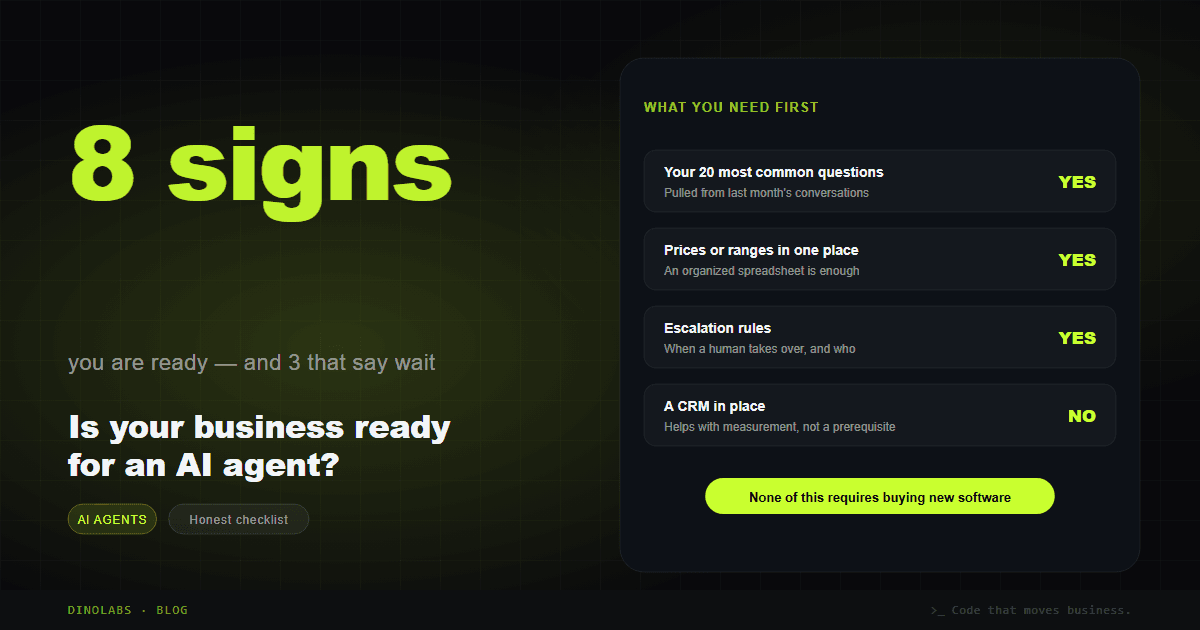
Is your business ready for an AI agent? Eight signs it is, and three that say wait
Most failed AI projects did not fail on the technology. They started at companies that were not ready. Here are the signals that tell you which group you are in, before you spend a dollar.
A business is ready for an AI agent when it has repetitive conversation volume, answers a human gives over and over again, and someone with the authority to decide what the agent should say. You do not need perfect processes or a sophisticated CRM. You do need to know which questions arrive, what the right answer is, and what happens when the agent does not know. Without those three, any implementation becomes a chatbot that sounds polished and resolves nothing.
Published on September 3, 2026
What an AI agent for business does, and what it does not
Before asking whether you are ready, it is worth pinning down the term, because it gets used for wildly different things.
An AI agent for business is not a menu tree or a searchable FAQ. It is software that understands what a customer writes in their own words and takes real actions: checks availability, builds a quote, books an appointment, logs the customer, alerts the right person. How that differs from a scripted chatbot, and when a custom build beats an off-the-shelf tool, we cover in this comparison.
The list of things it does not do matters just as much:
- It does not replace your sales team. It filters, answers the repetitive part and hands over a warm contact. Closing stays human.
- It does not invent policy. It answers inside the limits you define. If you never tell it what discount it can offer, it offers none.
- It does not fix a broken process. If nobody today knows who handles what, automating that produces disorder faster.
- It does not guess your prices. It needs a source of truth: a list, a sheet, a system. Something.
That last one stalls more projects than any technical constraint. The technology has been ready for a while. What is usually missing is the company having written down, somewhere, what the agent is supposed to say.
Eight signs your business is ready
You do not need all eight. With four or five, an AI agent typically pays for itself inside the first quarter.
- Messages arrive outside business hours. Nights, weekends, holidays. Every one of those is a sale cooling off while nobody answers.
- The same five questions are 70% of the volume. Price, availability, hours, location and "do you do X?". If that sounds familiar, you already know what to automate first.
- Someone on your team spends hours copying and pasting answers. That time has a monthly cost you can calculate today.
- You respond in hours, not minutes. The classic Harvard Business Review analysis found that contacting a lead within the first hour multiplies the odds of qualifying it several times over compared with waiting a day.
- You lose conversations and cannot say how many. If nobody can tell you how many inquiries arrived last month, that is problem number one, and an agent fixes it as a side effect.
- Your information exists in writing somewhere. A catalog, a price list, a rate sheet, even in a spreadsheet. That is enough to start.
- One person can make decisions. Someone who can say "this is the answer" and "this goes to a human". Without that person, projects die in review cycles.
- WhatsApp is a primary channel. For companies selling to Hispanic customers in the US, it usually is, and the official WhatsApp Business API connects to the number you already use.
Three signs you should wait
Saying no is part of the job. In these three cases, waiting is the right call, and saying so early saves real money.
- Low, erratic volume. At ten or fifteen messages a month, the savings do not cover the implementation. Automate when the volume hurts, not before.
- Every sale is different and highly technical. For custom projects where 80% of the conversation is specialist diagnosis, an agent is useful for scheduling and filtering, not for selling, and it should be scoped and priced that much smaller.
- There is no source of truth. If prices live in three people's heads and those heads disagree, that has to be sorted first. It is the company's work, and no vendor can do it for you.
There is a fourth case that is about expectations rather than technology: the company that wants the agent to "sell on its own". A well-built agent increases how many conversations get answered and how fast. That moves revenue, but closing still has an owner.
What you need in place before you start
The list is shorter than most people expect, and none of it requires buying new software.
| Requirement | Why it matters | If you do not have it |
|---|---|---|
| Your 20 most common questions | They are the agent's base script | Pull them from last month's conversations |
| Prices or ranges in one place | The agent needs a single source | An organized spreadsheet is enough |
| Escalation rules | Defines when a human takes over, and who | Settled in the kickoff meeting |
| A company messaging number | It is where the conversation lives | The one you already use works |
| Someone who can approve | Without a decision maker, projects stall | Without this, do not start |
Notice what is not on the list: no CRM required, no new website, no documented processes. All of those help. None of them is a prerequisite for a first agent.
How to tell if it pays for itself
This calculation takes ten minutes and decides the project better than any vendor deck.
- Count one week of inbound messages and multiply by four. That is your real monthly volume.
- Mark how many arrived after hours or waited more than an hour for a reply.
- Estimate how many of those were lost. Be conservative: if you do not know, use 20%.
- Multiply by your average ticket and your historical close rate.
The resulting number is what is being left on the table every month. Compare it against the cost of the agent. If the project does not pay back within three or four months under conservative assumptions, it is not the moment, and any honest vendor will tell you so. Response speed is the whole game here, which is why we treat it as an architecture problem in speed to lead.
There is a second saving almost nobody calculates: your team's time. If two people spend two hours a day answering the same things, that is eighty hours a month you can redirect to selling. And a third, harder to measure but real: perception. A customer who gets an answer in seconds assumes the company is serious, something decades of response time research keeps confirming.
How implementation actually works
A tightly scoped first agent goes live in weeks, not months. The order matters.
- Kickoff. Define which processes it handles, which it does not touch, and who it escalates to.
- Collect the source of truth. Common questions, prices, policies, hours.
- Build and connect channels. Messaging, website chat, and wherever the customer record lands.
- Test with real conversations. Not invented examples: the messages that actually arrived last month.
- Narrow go-live. One channel, one process, measured over the first week.
- Tune and expand. Real data corrects the script, then you add processes.
The most common sequencing mistake is launching every channel at once. An agent that handles one process well and expands later goes further than one handling five poorly, which is the same trap companies fall into with live chat when nobody thinks through who answers on the other side. For bilingual markets there is one extra consideration we cover in bilingual AI agents.
The mistakes that sink these projects
When an AI agent underperforms, it is almost never the model. It is one of these five.
- Infinite scope. It is asked to handle everything on day one, so it handles everything adequately and nothing well.
- No escalation rule. The agent does not know when to stop and hand over, and the customer ends up trapped in a loop.
- Stale information. A price list is loaded once and never touched again. Six months later the agent is confidently wrong.
- Nobody measures. Without conversations handled, response time and contacts generated, there is no way to know whether it worked.
- You do not own the code. If the agent lives in the vendor's account, the day you leave you start from zero. Negotiate that before signing, not after.
Frequently asked questions
How much message volume do I need for an AI agent to be worth it?
There is no universal minimum, but below roughly 150 to 200 messages a month the savings rarely cover the implementation, unless your average ticket is high. With large tickets, recovering a single lost sale per month can pay for the project, so run the math on your own numbers rather than an industry average.
Do I need a CRM before implementing an AI agent?
No. An agent can log contacts into a spreadsheet, its own database, or whatever system you already use. Having a CRM helps with measurement, but requiring one upfront is usually a way to postpone the project. If your operation lives in spreadsheets, start there and organize later.
Can the agent handle more than one language?
Yes, and it answers in whichever language it is written to without duplicating the script. For companies serving Hispanic customers in the United States this is decisive, because customers switch language mid conversation and the agent has to follow without losing context or tone.
What happens when the agent does not know something?
It transfers the conversation to whoever you designate, with the full history, following explicit rules. That escalation rule is defined during kickoff and is the difference between a useful agent and one that leaves customers going in circles. A well-built agent recognizes its limits instead of improvising.
How long does implementation take?
A first agent scoped to one channel and one process goes live in two to four weeks, including testing with real conversations. What stretches these projects is rarely development. It is how long the company takes to gather prices, policies and approved answers.
Can I start small and expand later?
That is exactly what we recommend. Start with the process that hurts most, usually answering after hours, measure for a month, and use that data to decide what to add. Starting with everything at once is the fastest route to a mediocre agent across five different fronts.
DINOLABS builds AI agents, automation and websites for companies in the United States, Mexico, Colombia and Switzerland. Agents run in your own accounts and the code lives in your repository from day one. Bogotá shares Eastern time, so meetings happen during your working hours.
If you want to know whether an agent pays for itself in your case, or whether it is too early, tell us how you handle inquiries today at AI agents and we will send an honest assessment based on your own numbers.